
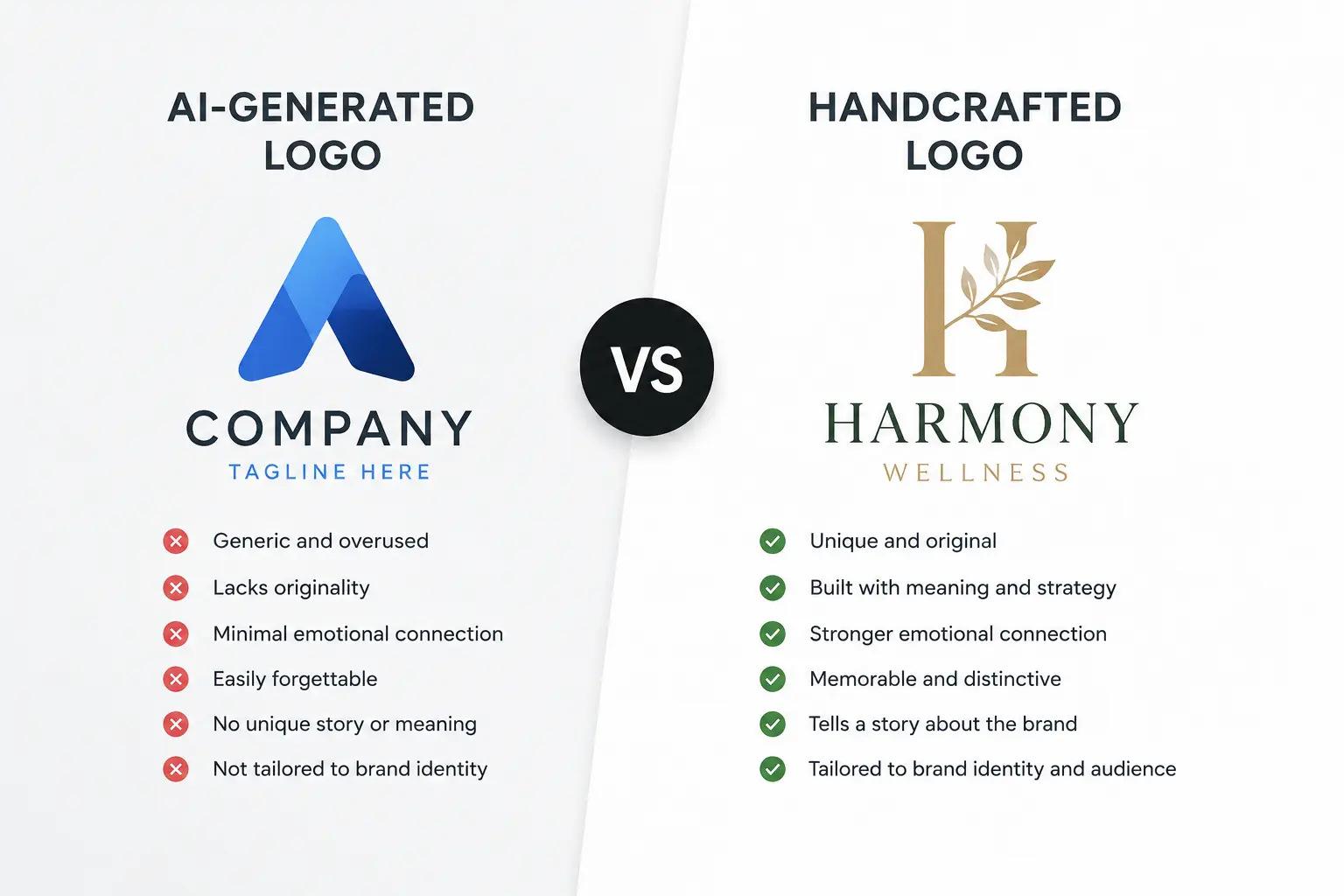
Type a prompt into an AI image generator and a “logo” appears in under a minute. It’s fast, it’s free, and for a business watching every dollar, it’s tempting. But speed is not the same as strategy. As AI-generated design floods every industry in 2026, the brands that actually stand out — and stay legally protected — are the ones hiring a professional graphic designer. A generated image is not the same as a brand asset you can legally own, protect, and build a company around like the work of a professional who understands originality and the real people behind the brief.
Quick answer: AI can generate an image in seconds, but it can’t guarantee that image is original, can’t transfer legal ownership of it to you, and can’t understand your brand. For any logo, ad, or asset you plan to trademark, publish, or build a business around, a professional graphic designer remains the safer and stronger investment in 2026.
Key Takeaways
- AI-generated visuals cannot be copyrighted under current U.S. law, which puts your brand’s most important asset in a legal gray zone.
- AI models are trained to statistically recombine existing work, which is why so many AI logos and ads start to look alike.
- A professional graphic designer studies your brand, audience, and goals before creating anything — AI only responds to a prompt.
- 2026 ad-performance data shows AI-identified creative converting worse than human-made creative, especially for higher-value purchases.
- Commissioning a real designer gives you a documented, contractual transfer of ownership — something no AI tool provides.
Jump to a section:
- The AI Design Boom vs. The Professional Graphic Designer
- Originality: Why a Professional Graphic Designer Creates While AI Recombines
- Why AI Doesn’t Understand Visual Concepts — It Predicts Them
- The Copyright Problem: You Don’t Own What AI Creates
- The Mistakes AI Still Makes (and Why They Matter for a Brand)
- Why AI Ads and Logos Are Starting to Blend Into the Background
- What a Professional Graphic Designer Actually Brings to Your Brand
- AI vs. Professional Graphic Designer: Full Comparison
- Inside the SEKAI Designs Process
- Frequently Asked Questions
The AI Design Boom vs. The Professional Graphic Designer
AI image and logo generators exploded in popularity because they solve one problem extremely well: speed. A founder with no budget and an approaching launch date can generate dozens of options in the time it would take to write a creative brief for a human designer. That convenience is real, and it’s why so many small businesses reach for AI first. The problem shows up later — when that “logo” needs to go on a trademark application, a storefront sign, an embroidered hat, or a billboard, and it starts falling apart in ways a quick preview never revealed.
1. Originality: Why a Professional Graphic Designer Creates While AI Recombines
Generative AI models don’t design from a concept — they predict the statistically likely next pixel based on patterns learned from millions of existing images. That’s a powerful trick, but it’s fundamentally different from original creative thought. A professional graphic designer starts a project the way SEKAI Designs approaches every commission: as a blank canvas, built from research, sketches, and iteration specific to one brand — not a probability distribution trained on everyone else’s work.
This is also why every SEKAI Designs project is built from scratch under a strict creative-integrity policy rather than recycled from templates or generated output. You can read exactly how that originality guarantee works in the studio’s Terms of Service & Design Policy, and see the results across a range of styles in the portfolio — from neon signage to minimalist branding.
2. Why AI Doesn’t Understand Visual Concepts — It Predicts Them
A logo isn’t just a shape; it’s compressed strategy. Why does a certain curve feel trustworthy? Why does a particular color read as premium instead of cheap? Why does negative space matter more in a favicon than on a billboard? A professional designer answers those questions by understanding the brand, the audience, and the competitive landscape before a single pixel is placed. AI has no access to that context unless a human feeds it in — and even then, it’s guessing at symbolism, not understanding it. That gap is exactly why the decade of experience behind SEKAI Designs across brand identity, typography, and 3D environment design exists as a discovery process, not a single prompt.
3. The Copyright Problem: You Don’t Own What AI Creates
This is the part most businesses find out too late. Under current U.S. law, purely AI-generated images are not eligible for copyright protection, because copyright requires a human author. The U.S. Copyright Office has consistently refused to register works that lack human authorship, a position the Supreme Court left standing in March 2026 when it declined to hear an appeal in Thaler v. Perlmutter, a case that tested exactly this question.
In practice, that means a logo generated entirely by AI has no legal protection against a competitor copying it, no reliable trademark foundation, and no clear chain of ownership if the underlying model was trained on someone else’s copyrighted style. When you commission a human designer instead, ownership is contractual and documented: at SEKAI Designs, full rights transfer to the client upon final payment, spelled out plainly in the studio’s ownership and intellectual property policy — something no AI tool can offer.
4. The Mistakes AI Still Makes (and Why They Matter for a Brand)
Anyone who has generated AI artwork at scale has seen the same failure patterns repeat: garbled or misspelled text, warped linework, inconsistent proportions between variations, and colors that shift slightly every time the same prompt runs. Those glitches are easy to laugh off in a casual image, but they get expensive in a brand asset. A logo that looks fine as a preview can fall apart the moment it needs to scale down to a favicon, print in one color on an invoice, or get embroidered on merchandise. Professional design work is built and checked for exactly those real-world use cases from the start, delivered as organized, layered, production-ready files — not a flattened image pulled from a generator.
5. Why AI Ads and Logos Are Starting to Blend Into the Background
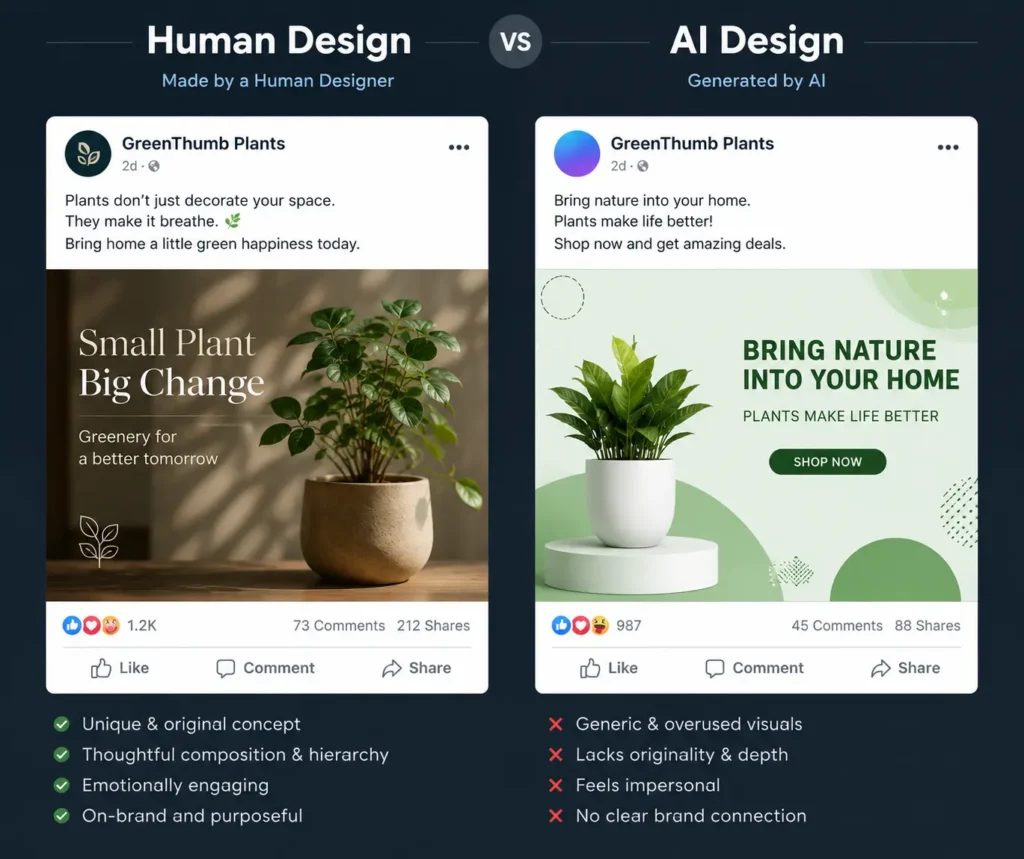
The bigger issue for marketing is sameness. Because most generative tools are trained on overlapping datasets, their outputs tend to converge on the same visual trends — similar gradients, similar fonts, similar layouts — regardless of the brand behind them. Scroll through enough ads in 2026 and it becomes obvious: a lot of them look like they came from the same template, because in a statistical sense, they did.
The data backs this up. Industry research from the IAB has found that younger consumers feel noticeably less positive about AI-generated advertising than the executives creating it assume, and the gap is widening year over year. Separate 2026 ad-performance benchmarking found that once audiences can identify a piece of creative as AI-made, perceived quality and purchase intent both drop, and AI-generated creative converts meaningfully worse than human-made creative for higher-value purchases. A visually distinct, hand-crafted identity doesn’t just look better — it performs better, because it’s actually memorable.
6. What a Professional Graphic Designer Actually Brings to Your Brand
A prompt gives you an image. A commission gives you a partner. Here’s what that difference actually includes:
- A discovery process that starts with your goals, audience, and competitors — not a text box.
- Iterative revisions based on real feedback, not re-rolled variations of the same prompt.
- Production-ready technical output: true vectors, organized layers, print specs, and pipeline-ready 3D assets for tools like Blender and modern game engines.
- A documented, contractual transfer of ownership once the project is complete.
- Accountability — a real person you can reach if something needs to change.
That last point matters more than it sounds. When a project moves from a 2D logo into 3D assets, HUDs, or interactive branding, or needs to work consistently across a full multi-asset identity system, that’s precisely the kind of complexity a generative tool cannot manage end-to-end — but a studio built around exactly that workflow can.
AI vs. Professional Graphic Designer: Full Comparison
Here’s how the two approaches actually compare, side by side, once you look past the speed of the first draft:
| Criteria | AI Image Generator | Professional Graphic Designer (SEKAI Designs) |
|---|---|---|
| Originality | Remixes patterns learned from training data. | Built from a blank canvas, tailored to your brand. |
| Legal ownership | Not copyrightable under current U.S. law. | Full IP rights transferred to you on final payment. |
| Brand strategy | No knowledge of your goals, audience, or competitors. | Built around a real discovery process. |
| Consistency across assets | Struggles to repeat the same style reliably. | Full identity systems engineered for consistency. |
| Typography & fine detail | Frequent distortion, broken kerning, and unreadable text. | Precision typesetting, checked by hand. |
| Production-ready files | Rarely delivers true vectors or print-ready formats. | Layered, scalable, print- and pipeline-ready files. |
| Audience impact | Increasingly recognized as generic; lowers CTR. | Distinct visual identity designed to be memorable. |
| Accountability | No one to contact when something’s wrong. | Direct relationship, contract, and defined revision rounds. |
| Long-term brand safety | Risk of copyright and trademark disputes. | Original-from-scratch guarantee, documented in writing. |
Inside the SEKAI Designs Process
SEKAI Designs is built around one idea: every brief deserves a blank canvas, not a template a philosophy shaped by over a decade of professional experience in graphic design and 3D artistry. Commissions span brand identity and logo design, HUDs and UI, animated and neon-style logos, and technical 3D assets built for Blender and real-time engines, all visible in the studio’s portfolio, including projects like SEKAI and Lueur.
The process is transparent from the first message: a deposit secures the project, a defined number of revision rounds keeps scope under control, and full ownership transfers to the client on final payment — all clearly laid out in the Terms of Service & Design Policy before any work begins. No guesswork, no fine print, and no AI-generated placeholder pretending to be a finished brand.
Frequently Asked Questions
Can AI completely replace a professional graphic designer in 2026?
No. AI can produce quick drafts and rough visual references, but it can’t guarantee originality, can’t transfer legal ownership of the final image, and can’t make the strategic brand decisions a project actually needs. Most studios — including SEKAI Designs — treat AI as a research or moodboarding tool at most, never as the final deliverable.
Is AI-generated art protected by copyright?
Under current U.S. law, no. The U.S. Copyright Office has repeatedly refused to register works that lack a human author, a position reinforced when the Supreme Court declined to hear Thaler v. Perlmutter in March 2026. That means a purely AI-generated logo has no legal protection against being copied by a competitor.
Why do so many AI-generated logos and ads look the same?
Generative AI tools are trained on massive, overlapping datasets and tend to converge on the same visual trends: similar gradients, similar fonts, similar composition. Without a human designer directing genuinely original choices, brands built on AI visuals often end up looking like everyone else in their category.
Is hiring a professional graphic designer more expensive than using AI?
The upfront cost is higher, but the value is different. A commissioned design comes with full ownership rights, defined revision rounds, technical production files, and a designer who can be held accountable if something needs to change. Factoring in the legal risk and rebrand cost of an unusable AI asset, a professional commission is often the more economical choice long-term.
What’s the difference between AI-assisted and AI-generated design?
AI-assisted design means a human designer might use AI as one small research tool inside a much larger creative process they still control from end to end. AI-generated design means the output — and its flaws — comes directly from the machine with no professional creative direction. SEKAI Designs builds every deliverable from scratch, by hand.
How do I commission a custom logo, brand identity, or 3D asset from SEKAI Designs?
Start by reviewing the portfolio and the Terms of Service & Design Policy, then reach out through the contact page with your project brief. Every commission begins with a deposit, a discovery conversation, and a design process built specifically around your brand.
AI is a useful tool for research, moodboards, and quick internal drafts. It is not a substitute for a professional graphic designer who understands your brand, owns the consequences of the work, and can hand you assets that are actually ready for the real world. This same principle now applies to search itself: Google has publicly stated that it rewards original, people-first material over generic, mass-produced content, whether that content is written or visual. If you’re ready for a logo, brand identity, or 3D asset built from scratch by a human — not a prompt — get in touch and start the commission process today.
Written by the team at SEKAI Designs — professional graphic design and 3D artistry with over a decade of combined industry experience. Learn more about the studio.