
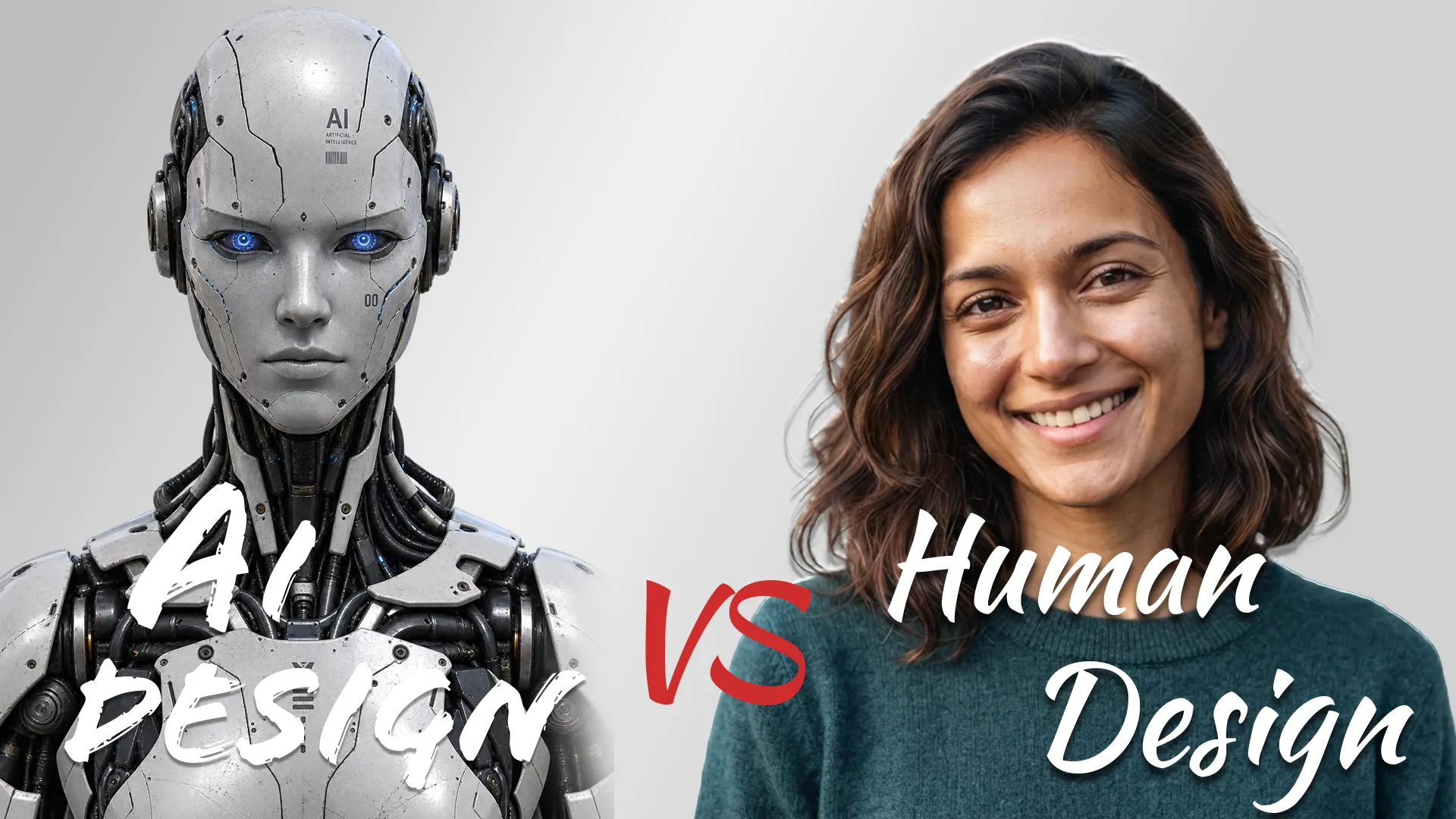
Quick answer: When it comes to AI vs graphic design, human-made wins on sales. A 2026 Ipsos and Syracuse University study of 3,000 consumers found human-made ads out-performed their AI-generated counterparts on sales-validated effectiveness by 16 points, even though most viewers could not tell which ad was which. Authentic, human-designed creative still converts better.
Every brand is being pitched the same promise right now: type a prompt, skip the design studio, get your ad out the same afternoon. It’s fast. It’s cheap. And for the first time, there’s real research measuring whether it actually sells anything. The early data isn’t kind to the shortcut.
The 2026 study that put real numbers on the debate
In May 2026, global research firm Ipsos published a study conducted with two faculty members from Syracuse University’s S.I. Newhouse School of Public Communications. It’s one of the first studies to compare AI-generated ads against human-made ads using the same standard Ipsos uses to predict real-world sales impact for its ad-testing clients.
The setup was straightforward. Researchers took 20 existing ads from 10 well-known brands, all produced before 2021 so there was no chance AI tools touched them. For each one, they generated an AI version built from the same strategic brief the human creative team had used. Then 3,000 U.S. consumers viewed the ads and rated them.
Two things stood out. First, consumers mostly couldn’t tell the difference: only 13% were confident an AI-made ad was AI-made, and that’s the exact same rate at which people wrongly flagged human-made ads as AI. Second, despite looking nearly identical to the eye, the ads did not perform the same. Using Ipsos’ sales-validated benchmark, the human-made ads scored 11 points above average. The AI-made ads scored 5 points below it. A 16-point gap between two sets of ads that most people couldn’t visually tell apart.
That’s the core finding worth sitting with: it isn’t that people can spot AI ads and punish them for it. It’s that something in the human creative process is producing ads that simply sell better, even when the surface looks the same.
AI vs graphic design: Why consumers still don’t trust AI-made ads
A separate 2026 study from IAB and Sonata Insights, based on surveys of over 500 Gen Z and Millennial consumers and 100 advertising executives, digs into the trust side of this problem — and the gap is widening, not closing.
AI use in ad creative has jumped fast: 83% of ad executives now say their company uses AI somewhere in the creative process, up from 60% just two years earlier. Consumer exposure has grown with it — 71% of Gen Z and Millennial consumers say they believe they’ve seen an AI-generated ad, up from 54% in 2024.
But executives are badly misjudging how their audience feels about it. 82% of ad executives believe Gen Z and Millennial consumers feel positive about AI-generated advertising. In reality, only 45% of those consumers actually do — a 37-point perception gap, up from 32 points two years ago. When asked to describe brands that use AI to generate ads, consumers reached for words executives rarely predicted: “manipulative” (20% of consumers vs. 10% of executives) and “unethical” (16% vs. 7%). Among Gen Z specifically, 30% called AI-using brands “inauthentic” and 24% called them “unethical.”
Interestingly, disclosure isn’t the villain here. 73% of Gen Z and Millennial consumers said knowing an ad was AI-made would either increase their likelihood to purchase or make no difference at all. The problem consumers are reacting to isn’t the label “AI.” It’s generic, off-brand, forgettable creative — which AI tools produce a lot of when there’s no trained designer directing the output.
The real dividing line: detectable vs. undetectable AI creative
A field study published in early 2026, run with researchers from Columbia, Harvard, TU Munich and Carnegie Mellon using live campaign data from a major performance-advertising platform, adds an important nuance. It found that for video ads longer than 15 seconds, human-made creative delivered 28% higher performance than AI-made creative. But the researchers’ broader conclusion wasn’t “AI always loses.” It was that detectable AI creative underperforms — ads that read as generic, templated, or slightly “off” — while creative that’s been shaped by someone with real creative judgment, whether human-made or human-directed AI, holds up.
In other words, the source of an ad matters less than whether it feels considered. That’s exactly what a trained graphic designer is trained to do: take a brief, understand a brand, and make deliberate choices that a prompt can’t replicate on its own.
Why professionally designed branding still wins on ROI
This isn’t just about ad creative in isolation — it holds up at the brand level too. Research from Lucidpress (now Marq), based on its ongoing State of Brand Consistency studies, has repeatedly found that companies with consistently, professionally presented branding see revenue increases in the 23–33% range compared to companies with inconsistent, off-brand visuals. A separate, widely cited Loyola University study found that a consistent brand color system alone can lift brand recognition by up to 80%.
Put together, the 2026 research tells a consistent story: AI can produce something that looks like an ad. It’s much less reliable at producing something that builds a brand people trust and buy from repeatedly. That’s the real story behind AI vs graphic design, and the gap custom graphic design services are built to close.
What this means if you’re advertising in 2026 AI vs graphic design
None of this means AI is useless it’s a legitimate tool for research, first-draft concepting, and speeding up production. But the 2026 data is fairly clear about where the line should sit:
- Use AI for the messy middle, not the final asset. Brainstorming, moodboards, and copy drafts are reasonable places for AI to save time.
- Keep a trained designer on anything customer-facing. Logos, hero ad creative, packaging, and anything meant to build long-term brand recognition are exactly where the human vs AI performance gap shows up.
- Be consistent, not just fast. The revenue lift from consistent branding (23–33%) dwarfs whatever time you save by skipping a designer.
- If you do use AI, disclose it. The data shows disclosure rarely costs you sales — hiding it and getting caught is the bigger risk to trust.
The bottom line of AI vs graphic design
Set side by side, the 2026 research is consistent: AI can produce something that looks like an ad, but it is far less reliable at producing something that builds a brand people trust and buy from again. That is the gap professional graphic design closes — and it is why, when you weigh AI vs graphic design for anything customer facing, the data still favors a trained designer.
Get authentic, human made graphic design for your brand
Sekai Designs builds custom graphic design and branding for businesses that would rather have real sales impact than a fast, generic ad. Every logo, ad creative, social graphic, and brand identity system we produce is designed from scratch by a human designer around your actual brief never AI generated, never templated, never “close enough.” When you’re weighing AI vs graphic design for your next campaign, browse our graphic design portfolio to see actual humaN made work.
If the 2026 data above sounds like your business is currently leaning too hard on AI-generated visuals, or you’re starting from scratch and want it done right the first time, we’d like to hear about your project.
Contact Sekai Designs through our project form and tell us a bit about your brand, your timeline, and what you’re trying to sell more of. We’ll follow up personally — no AI-generated reply, no automated quote bot.
Sekai Designs · Graphic Design & Branding Insights · Published August 21, 2026 · Updated August 21, 2026