
Est. reading time 11 minutes
Updated August 2026
Key Takeaways
- Second Life HUDs, VRChat world identities, FiveM server logos, and IMVU shop branding aren’t generic logo jobs — they’re platform-specific technical builds most freelancers, and every AI generator, tend to get wrong.
- A growing share of “fully custom” listings on marketplaces like Fiverr are quietly AI-generated and lightly touched up — the preview image usually looks fine, so buyers rarely catch it before paying.
- AI-generated images aren’t eligible for copyright protection under current U.S. law, so a seller reselling AI output never actually owned the design, and can’t prove it’s genuinely theirs to hand over to you.
- VRChat has logged an all-time concurrency record above 158,000 users, and IMVU reports 7M+ monthly active users — these are large, active creator economies, not niche hobbies.
- A designer worth hiring for this work can show finished, in-platform results — a HUD that functions, a logo that renders correctly in-engine, a texture that doesn’t warp on a mesh — and can walk you through how it was actually made.
- Why Second Life and VRChat Need a Different Kind of Graphic Designer
- The Marketplace Trap: When “Custom” Is Secretly AI
- A Graphic Designer for Second Life: Logos, HUDs, Unpackers & Event Graphics
- A Graphic Designer for VRChat: World Branding, UI & 3D-Ready Assets
- FiveM & Roleplay Servers: Logos & Server Branding
- IMVU: Badges, Banners & Shop Branding
- Sims & Other Creator Platforms
- What to Check Before You Commission a Second Life or VRChat Designer
- Inside the Process: Your Second Life and VRChat Designer at Work
- Frequently Asked Questions
Why Second Life and VRChat Need a Different Kind of Graphic Designer
A logo for a coffee shop only has to work as a flat image. A logo for a Second Life store, a VRChat world, or a FiveM server has to survive a lot more. It might get carved into a HUD, stretched across a mesh, dropped into a game engine, or scripted to change texture on click. Most general-purpose designers — human or AI — have never touched any of that. That’s exactly why a graphic designer for Second Life and VRChat needs a different skill set than someone who only builds flat, web-based branding.
That’s the gap SEKAI Designs was built around. The studio’s own comparison of professional graphic design versus AI-generated design covers the broader case for hiring a human: original work, real ownership, and a designer who understands why a decision was made instead of statistically guessing at it. This piece goes one layer deeper. It shows what that actually looks like once your brand lives inside a virtual world instead of just on a website.
The Marketplace Trap: When “Custom” Is Secretly AI
Most people looking for a graphic designer for Second Life and VRChat start the same way: they open Fiverr, Upwork, or a “hire a designer” post in a Discord server. From there, they look for someone who can build a Second Life HUD, a VRChat world artist, a FiveM server logo, or an IMVU texture. That’s a perfectly reasonable place to start — plenty of genuinely skilled, hands-on designers work through those platforms every day.
The problem is newer, and it’s easy to miss. A growing number of listings advertised as “fully custom design” aren’t custom at all. Instead, a seller takes your brief and drops it straight into an AI image generator, tidies up the result a little, and delivers it as hand-made branding. Sometimes it’s done within the hour, at a price that should have been the first clue.
The preview image almost always looks fine. That’s exactly why it’s a trap.
Why AI-Made “Custom” Work Isn’t Actually Yours
Here’s the part most buyers only find out after they’ve already paid: under current U.S. copyright law, an image generated purely by AI isn’t eligible for copyright protection, because copyright requires a human author. In practice, that means:
- The seller never legally owned the design to begin with, so no listing, invoice, or “full rights included” promise can transfer something that was never theirs.
- If another store or server ends up using something that looks suspiciously similar to your logo or HUD, there’s no original, protectable work to point to, and no real way to prove it was taken from you.
- If you ever need to prove the branding is genuinely yours, for a trademark, a dispute, or simple peace of mind, there’s no authorship trail to fall back on. An AI generating something from a prompt isn’t the same as a documented commission.
The quality often matches the risk. The same failure patterns that show up in any AI-generated image tend to show up here too: warped fine detail, proportions that shift between the preview and the final file, text that looks slightly off once you actually zoom in. The only difference is a human name attached to the listing.
How to Spot It Before You Pay
- The seller can’t show sketches, drafts, or a working layered file — only a finished export.
- Every piece in their portfolio has the same slightly-off gloss, the same generic gradient, the same “almost right” typography.
- Turnaround is suspiciously instant for something billed as fully custom branding.
- Asking directly, “did you use AI for this?” gets a vague or defensive answer instead of a straight one.
This is exactly the gap a real, hands-on studio closes. Every logo, HUD, unpacker, and 3D asset from SEKAI Designs is built from scratch — no AI shortcuts, no recycled templates — with real ownership transferred to you in writing once the project is done.
A Graphic Designer for Second Life: Logos, HUDs, Unpackers & Event Graphics
- Logos — store marks, brand identities, and animated or neon-style logos for landing points and marketplace listings.
- HUDs / UI — functional heads-up displays with correctly sliced textures and working button states, not just a flat mockup.
- Unpackers — the redelivery and unboxing interface customers see the moment they open a purchase.
- Event & venue branding — posters, participating-designer rosters, and promotional graphics for launches and fairs.
Est. 500K+ active users on Second Life’s own reported figures
A Graphic Designer for VRChat: World Branding, UI & 3D-Ready Assets
- World & community branding — a visual identity consistent across your world’s UI, Discord, and social presence.
- 3D-ready logos — marks built to survive being applied to a mesh or rendered inside Unity, not just flattened PNGs.
- Event graphics — promotional assets for meetups, concerts, and community gatherings inside the platform.
158,192 concurrent users — VRChat’s current all-time record, per Road to VR
FiveM & Roleplay Servers: Logos & Server Branding
- Server & faction logos — badge-style emblems for police, EMS, gangs, and general server identity.
- Discord & loading-screen branding — banners, icons, and loading art that match the server logo.
- Website & listing graphics — assets sized correctly for server directories and social pages.
IMVU: Badges, Banners & Shop Branding
- Shop & badge design — store banners, achievement-style badges, and catalog thumbnails.
- Texture design — UV-accurate textures for clothing and accessory meshes.
7M+ monthly active users, per IMVU’s own newsroom
Sims & Other Creator Platforms
What to Check Before You Commission a Second Life or VRChat Designer
Whether you’ve found a graphic designer for Second Life and VRChat through a marketplace, a referral, or a portfolio site, run through this list before you pay anything:
- Platform-specific proof. Ask to see finished work actually functioning in Second Life, VRChat, FiveM, or IMVU — not just a flat image mockup.
- A straight answer about AI. Ask directly whether AI tools were used to generate the design. If a “custom” piece is really AI output with light touch-ups, the seller often can’t answer clearly — and even a truthful “yes” means the design likely isn’t something they can legally transfer to you in the first place.
- Written ownership terms. Confirm exactly when rights transfer to you, ideally in a published terms of service, not a verbal promise.
- Defined revision rounds. Know upfront how many rounds of feedback are included before extra revisions cost more.
- Production-ready delivery. Ask what file formats you’ll receive — layered files, correct textures, and working scripts, not a single flattened export.
- A real discovery step. A designer who asks about your brand, audience, and platform before quoting a price is planning a strategy, not guessing.
Inside the Process: Your Second Life and VRChat Designer at Work
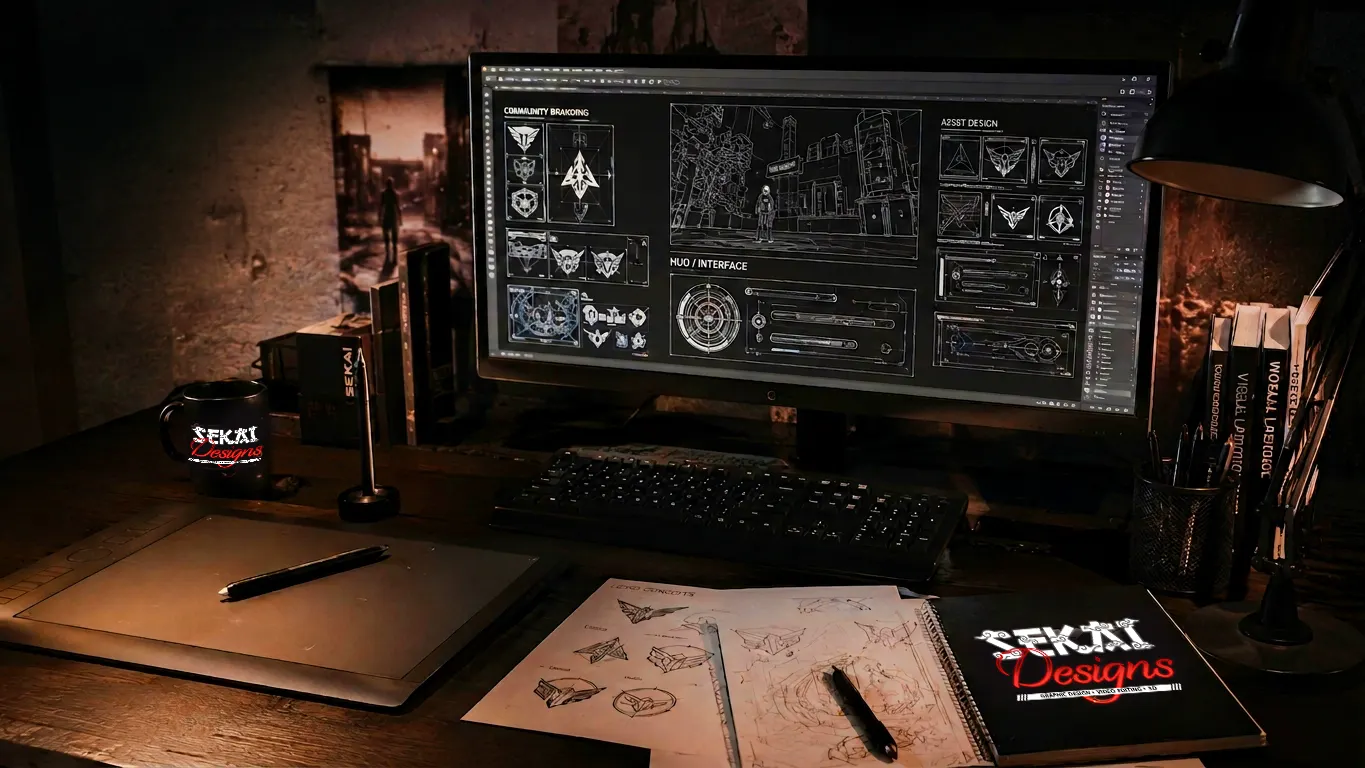
As a graphic designer for Second Life and VRChat, SEKAI Designs treats every commission the same way it treats any other brand: as a blank canvas, not a template. That’s true whether it’s a Second Life HUD, a VRChat world identity, a FiveM server logo, or an IMVU shop banner. The studio spans logos, HUDs/UI, unpackers, branding, and animated or neon-style logos, alongside 3D assets built for Blender and real-time engines. Every project starts with a deposit, and a defined number of revision rounds keeps scope under control. Full ownership then transfers to you on final payment, all laid out in advance in the Terms of Service & Design Policy.
Ready to Brand Your World?
Tell us your platform, your project, and your vision. Every commission starts with a short brief so we can scope it properly before any design work begins.
Frequently Asked Questions
Can I just use an AI logo generator for my Second Life or VRChat brand?
You can, but it usually causes problems later. AI generators don’t understand in-world constraints like HUD scripting, mesh UV layouts, or transparent PNG requirements, and the output isn’t reliably copyrightable, which matters if another creator copies your store or event branding. A human designer who already works inside these platforms builds the asset correctly the first time and gives you documented ownership of it.
Is it safe to hire a designer through Fiverr or Upwork for my Second Life, VRChat, or FiveM branding?
It can be — many freelancers on those platforms do genuinely hands-on work. The real risk is a seller who quietly runs your brief through an AI generator and delivers the result as custom branding. Because AI-generated images aren’t eligible for copyright protection under U.S. law, that seller never truly owned the design and can’t transfer real ownership to you, and the output often carries the same quality issues as any AI image: warped detail, generic style, text that doesn’t hold up under a closer look. Ask to see a working file or sketches, and ask directly whether AI was used, before you commit.
What’s the difference between a HUD designer and a regular graphic designer?
A regular graphic designer creates flat images. A HUD designer also understands how that image needs to be sliced, scripted, and attached so it functions as an interactive heads-up display in Second Life or a similar platform, including button states, texture alignment, and performance. SEKAI Designs builds both the visual and the functional side of a HUD, not just the artwork.
Do you design for FiveM and GTA roleplay servers?
Yes. Server logos, Discord and loading-screen branding, and roleplay community identity are treated the same way as any other brand commission: built from scratch around your server’s theme, with production-ready files for your website, Discord, and in-game assets.
Can a designer make a logo that also works as a 3D object, not just a flat image?
Yes. SEKAI Designs builds animated, neon-style, and true 3D logo assets for use inside game engines and platforms like VRChat and Second Life, alongside standard 2D brand marks for your website and social pages, so the same identity holds up in both flat and in-world formats.
How do I commission SEKAI Designs for Second Life, VRChat, FiveM, or IMVU?
If you’re looking for a graphic designer for Second Life and VRChat, start by reviewing the portfolio and the Terms of Service & Design Policy, then submit your project through the commission form with your platform, deliverables, and any references. Every commission starts with a deposit and a short discovery conversation before design work begins.
Do I own the final files once the project is done?
Yes. Full ownership transfers to you on final payment, spelled out in writing in the studio’s Terms of Service & Design Policy, which is not something an AI generator or an unclear freelance arrangement can guarantee.
Whichever world you’re building in, the brief is the same: original work, built by hand, that you actually own. Start your commission and tell us what you’re building.